
From ERP to Agent Mesh: How Agentic AI Will Rewire the University

For decades, universities have bolted together ERP systems, SIS platforms, and SLCM suites to manage their complexity. A new paradigm is emerging — one where autonomous AI agents don't just automate tasks, but actively govern, coordinate, and continuously improve every dimension of academic and administrative life.

Walk into any university's IT war-room today and you will find the same set of software: an Enterprise Resource Planning (ERP) system managing finance and HR, a Student Information System (SIS) housing admission and academic records, and a Student Lifecycle Management (SLCM) platform trying to stitch the student journey together.
These systems are powerful — but they are, at their core, record-keeping and workflow-routing machines. They do what humans configure them to do. They do not think, anticipate, or adapt.
The arrival of agentic AI changes this Paradigm entirely.
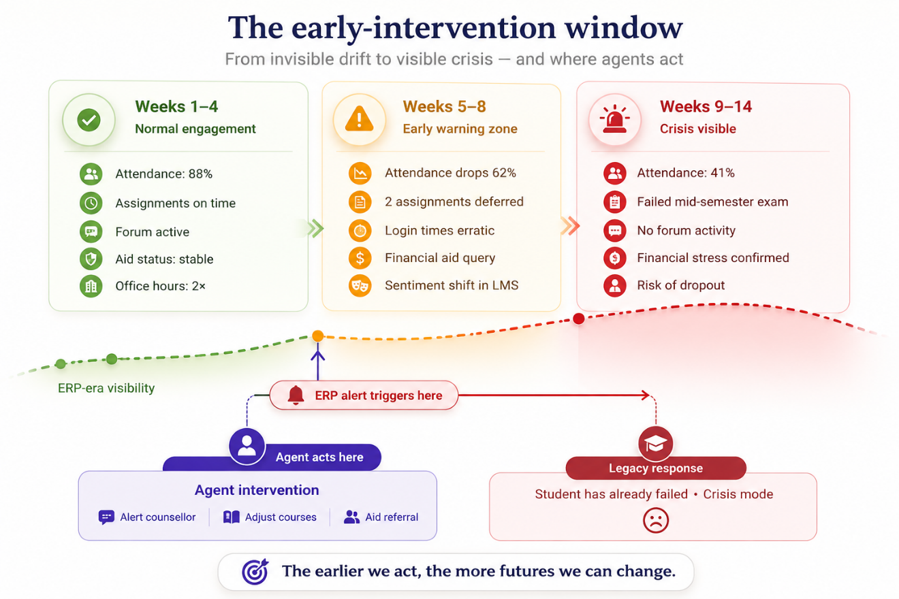
An ERP system processes student attendence. An AI agent, by contrast, notices declining attendance patterns three weeks earlier, flags the at-risk student to a counsellor, and adjusts the course recommendation engine — before the student ever files a form.
PART I - The Legacy Architecture and Its Limits
The traditional university technology stack evolved through accretion. An ERP (SAP, Oracle, or Workday) arrived first to manage payroll, procurement, and finance. A SIS (Banner, PeopleSoft, Ellucian) was layered on to track student records, grades, and enrolment. SLCM platforms then tried to orchestrate the entire student lifecycle — from inquiry to alumni — across these silos.
The result is a system that is vast but fragmented. Data lives in isolated modules. Integration is expensive, brittle, and dependent on IT teams. More critically, these systems are reactive: they record events after they happen, route approvals through fixed workflows, and generate reports that administrators read after the decisions they were meant to inform have already been made.
ERP / SIS / SLCM vs. Agentic AI — Capability Comparison

PART II - The Architecture of the Agentic University

Agentic AI refers to systems where one or more large language models (LLMs) are equipped with tools, memory, and the ability to plan multi-step actions autonomously. In a multiagent configuration, specialised agents collaborate — each owning a domain, each capable of delegating to or querying others — orchestrated by a supervisory meta-agent that maintains institutional goals and policy guardrails.
Think of it not as replacing the SIS with a smarter SIS, but as deploying a mesh of intelligent actors who use the underlying data systems as instruments — while reasoning, prioritising, communicating, and continuously learning above them.
The Agent Mesh — Illustrative Domain Map

What makes this more than a collection of AI-powered chatbots is the coordination layer. Agents communicate asynchronously, share a unified institutional memory, and escalate to human decision-makers only when genuinely novel judgement is required. The Accreditation Agent, for instance, can pull live data from the Curriculum Agent and the Faculty Agent to update NAAC criterion scores in near real-time — something that today takes weeks of manual data harvesting.
PART III - Five Transformations Already Within Reach
1 — From Reactive Reporting to Predictive Governance
Current BI dashboards tell leaders what happened last semester. Agentic systems will model what is about to happen — flagging declining enrolment in a programme three semesters before the crisis, or identifying a faculty retirement cliff before succession planning becomes impossible. Leadership shifts from reading the dashboard to directing the agent's priorities.
2 — Hyper-Personalised Student Success Pathways
The Academic Advising Agent will maintain a living model of each student: learning style signals, engagement rhythms, financial stress indicators, career ambitions. It will not wait for a student to fail a paper before intervening; it will notice the earlier pattern — falling assignment submissions, erratic login times, shifting forum sentiment — and act accordingly, coordinating with the counselling team and the financial aid office simultaneously.
3 — Always-On Regulatory Compliance
Indian universities operate under an extraordinarily complex compliance environment: UGC, AICTE, NAAC, NBA, NIRF, BCI, PCI, NMC — each with its own data requirements, timelines, and evidence formats. An Accreditation Agent that continuously ingests institutional data, maps it to criterion frameworks, and maintains a live readiness score would compress the NAAC cycle from a three-year preparation sprint into a continuous, ambient process. The question shifts from "Are we ready for assessment?" to "What is our real-time readiness score today?"
4 — Intelligent Resource Orchestration
Timetabling, lab allocation, library procurement, hostel management, infrastructure maintenance scheduling — these are domains where constraint satisfaction at scale is precisely what LLM-powered planning agents excel at. The Finance Agent coordinating with the Academic Scheduling Agent can optimise room utilisation in ways that no human planner, working with spreadsheets, could attempt.
5 — Research Amplification
India's universities are under growing pressure to improve research output. A Grants Agent that monitors 200 funding sources, matches them to faculty profiles, drafts a pre-proposal, and flags the application deadline is not science fiction — every component technology exists today. What is missing is the institutional will to deploy it, and the governance frameworks to do so responsibly.
PART IV - The Non-Negotiables: Governance, Trust, and the Human-in-the-Loop

None of this is an argument for removing humans from university governance. Quite the opposite. Agentic AI systems, precisely because they operate at scale and speed, require more deliberate human oversight — not less. The governance architecture matters as much as the technical architecture.
Five Governing Principles for the Agentic University

PART V - The Transition: Neither a Big Bang Nor a Long Drift
The transition from the ERP era to the Agent Mesh era will not happen overnight, nor should it. Universities that attempt wholesale replacement of their SIS with an agentic layer before they have the data quality, the governance frameworks, or the organisational trust to support it will fail — not because the technology is wrong, but because the institution was not ready.
The pragmatic path is domain-by-domain augmentation. Begin with the highest-value, lowest-risk domain: typically placement intelligence or admissions analytics. Build the governance muscle. Generate institutional trust. Then expand the agent mesh one domain at a time, always keeping the human-in-the-loop at consequential decision points.

The ERP was the nervous system of the 20th-century university: it kept the institution's body running. The Agent Mesh is the cognitive layer of the 21st-century university: it enables the institution to think at scale. The question for institutional leaders is not whether to build it, but how soon, how carefully, and with what values embedded at its core.
The University Has Always Been a Community of Inquiry
Agentic AI does not change that. It frees the humans within it — faculty, administrators, students — to spend more of their finite attention on what only humans can do: mentoring, discovering, creating, and judging. The technology is ready. The question is whether the institution is.


Comments