
India's Universities Have a Budget for a Helipad. But Not for Intellectuals.

Here is a question worth sitting with:
When did the visiting-day brochure become more important than what happens on every other day of the year?
India's higher education sector has crossed 4,000 institutions. The Gross Enrolment Ratio has climbed to nearly 28%. On paper, the numbers look like ambition.
But walk through admissions season and a different picture forms.
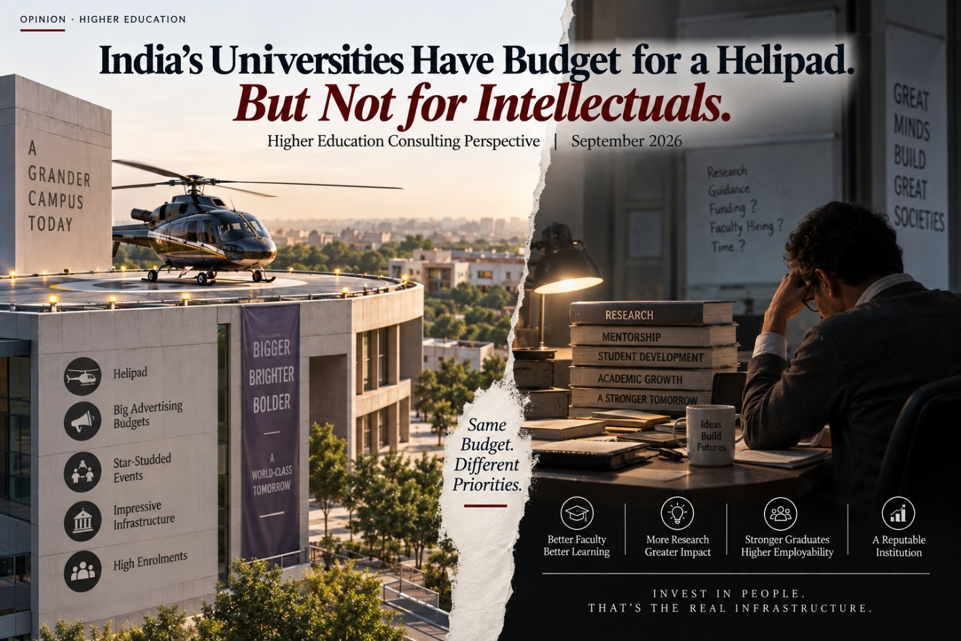
A university in a Tier-2 city recently commissioned a helipad on the roof of its administrative block — complete with a ceremonial landing zone, LED-lit perimeter markers, and a three-page press release about its "world-class connectivity."
The same institution had not hired a single faculty member with a funded research project in three years.
The helipad gets newspaper coverage. The research gap gets silence.
The Admission Carnival
Walk through any private university's admissions cycle and count what you see.
Drone footage. Brand ambassadors. Outdoor hoardings on every arterial road into town. WhatsApp broadcast campaigns. Virtual reality campus tours. Retargeting ads that follow prospective students across social media for weeks.
The sophistication of the enrolment funnel would impress a growth-stage startup.
Now ask: what fraction of that budget went toward supporting a faculty member's UGC research proposal, funding a student's conference travel, or simply paying a truly exceptional academic what she is actually worth?
In most cases, the honest answer is: the question was never framed that way.
A Hospital Analogy Nobody in Higher Education Wants to Hear
Imagine a private hospital that invested its capital thus:
Marble lobby. Concierge desk. Valet parking. A signature fragrance pumped through the HVAC. A PR agency to manage its reputation.
And then, when it came time to hire a cardiologist with 18 years of experience and a record of successful complex procedures —
"Can we offer ₹10 lakh less and see if she takes it?"
We would rightly call that hospital dangerous.
Yet in higher education, an analogous trade-off is treated as prudent financial management.
The student who enrols in a university is not buying marble. She is buying the quality of the mind that will shape hers.
The Convocation Spectacle
Indian universities have become extraordinarily good at the convocation.
Stadium-scale venues. Governors in attendance. Ministers on dais. Elaborate academic processions. Gold medals awarded to rank holders for answering examination questions well.
What we are less good at:
Ensuring that the people who taught those rank holders were paid, supported and retained well enough to stay for the next batch.
Convocation celebrates the output. It does not interrogate the process.
A student who memorised well, in a university where she was never taught to think originally, will receive the same scroll as one who was genuinely transformed.
We film the ceremony. We rarely film the classroom.
The Inverted Investment Logic
Private higher education in India has, over two decades, built a capital allocation pattern that looks approximately like this:
Campus aesthetics → Advertising → Events → Admissions → Administration → Faculty
Faculty lands at the bottom of the priority stack.
Turn it upside down and you have what every institution that has built a durable academic reputation actually did:
Faculty → Pedagogy → Research → Graduate quality → Employer trust → Student demand → Revenue → Infrastructure
The shortcut is to start with the last item and work backwards. Many institutions have chosen the shortcut.
It produces enrolment. It does not produce reputation. And reputations compound; enrolment numbers do not.
The Stationery Negotiation
There is a peculiar phenomenon in private university HR.
When a vendor quotes ₹8 lakh for a media campaign, the conversation moves quickly. When a creative agency bills ₹12 lakh for a brand refresh, it gets approved.
But when a scholar with a PhD from a reputed institution, three published papers, and a pending DST grant asks for ₹18 lakh per annum —
"That is above band."
"Can she join at ₹14 lakh?"
"Let us see what she counters with."
We negotiate intellectual capital the way we negotiate office stationery.
The media campaign will be forgotten in six months. The faculty member, if retained and supported, can influence the intellectual trajectory of 200 students per year for the next decade.
The math is not complicated. The priorities, however, are.
What the Graduate Employability Number Actually Measures
India's graduate employability sits at under 55%. That figure is usually discussed as a curriculum problem, a skills-gap problem, or a university-industry alignment problem.
All of those diagnoses contain truth. But underneath each of them is a prior question:
Who taught this graduate?
Was that person deeply current in their field — or simply current enough to pass the UGC minimum qualification?
Did they have time to mentor, research, and stretch their students — or were they managing an 18-hour teaching load because the institution kept faculty numbers lean?
Were they invested in the institution — or already updating their resume because they had been offered ₹15,000 more per month elsewhere and the management did not think it worth matching?
Employability is the output. Faculty quality and support are upstream variables.
We obsess over the output. We under-invest in the variable we can actually control.
The Things That Depreciate and the Things That Compound
A smart building becomes ordinary in five years when every competing campus builds one too. A gaming zone becomes dated. A helipad on the roof is a conversation piece until the next institution commissions a more dramatic one.
But a professor who publishes, mentors, attracts funded projects and builds genuine intellectual culture —
Her impact compounds.
The student she challenged at 20 will, at 40, credit that pressure for a career she is proud of.
The research paper co-authored with her students opens doors that no placement brochure can.
The consultancy project she brings to campus creates industry relationships that outlast any MoU signing ceremony photographed for the annual report.
This is what academic capital looks like.
It does not photograph as well as a helipad. But it is the only asset the institution owns that genuinely appreciates.
A Simple Question for Every Governing Board

Take ₹1 crore.
Option A: Drone video, a brand refresh, two celebrity sessions for freshers, and a premium waiting lounge for prospective parents.
Option B: Hire four exceptional academics at ₹20 lakh, with ₹5 lakh each in research and pedagogical development support. Retain them.
Audit the outcome in seven years.
Which option changed what a student could do in the world? Which option built something no competitor can easily replicate?
Students are not paying for the building. Parents are not investing in the café. Employers are not hiring the campus.
They are hiring the person who graduated from it — and that person is the sum, above all, of the teachers who refused to let her think small.
India does not need more universities with better amenities.
India needs more universities with better priorities.
And if your institution can afford the helipad but cannot afford the intellectual —
the problem was never the budget.
It was what you thought education was for.


Comments