
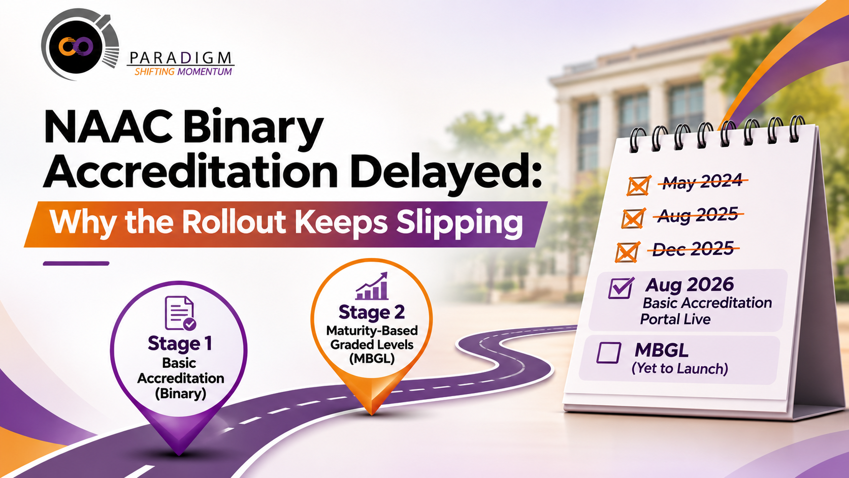
Promised for 2024, still arriving in 2026
NAAC's binary accreditation was meant to start by May 2024, with maturity-based levels by December 2024. Nearly three years after it was announced, the new framework is only now reaching institutions, and its second stage has yet to arrive.
In January 2024, the Ministry of Education announced that NAAC would replace its A++ to C grades with a simple "accredited or not accredited" outcome, followed by five maturity levels. Since then, the launch date has been revised at least four times, and a Basic Accreditation portal went live only in August 2026.
For Vice-Chancellors, IQAC coordinators and principals, this is not an academic question. Grades are expiring, re-accreditation plans are on hold, and several regulatory benefits still depend on a NAAC score. So why has the binary framework taken so long, and what should institutions do while they wait?
What the binary framework promises
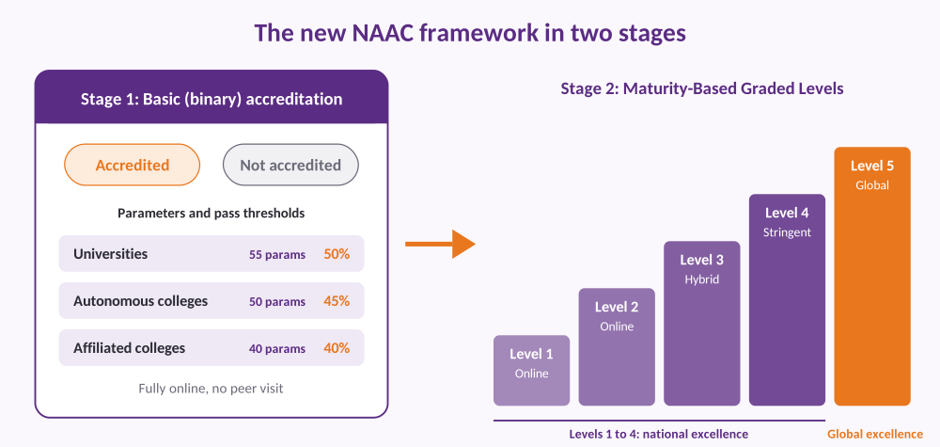
The reform comes from the committee led by Dr K. Radhakrishnan, former ISRO chairman, which the Ministry set up in November 2022. It has two stages.
Stage 1: Basic (binary) accreditation
An institution is declared either accredited or not accredited, with no score or grade. Under the proposed design, universities would be assessed on 55 parameters, autonomous colleges on 50 and affiliated colleges on 40, with pass thresholds of 50%, 45% and 40% respectively. There would be no physical visits; documents would be checked online and validated by about 100 randomly selected stakeholders.
Stage 2: Maturity-Based Graded Levels (MBGL)
Accredited institutions climb from Level 1 to Level 5. Levels 1 to 4 signal national excellence and Level 5 signals global excellence. Levels 1 and 2 are meant to be achievable online, Level 3 is hybrid, and Levels 4 and 5 carry stringent criteria.
The goal is ambitious. Only about 40% of universities and 18% of colleges are accredited today, and NAAC wants to cover over 90% of institutions within five years.
A timeline of revised dates
Every announcement since January 2024 has carried a target date, and each has been revised as the work progressed.
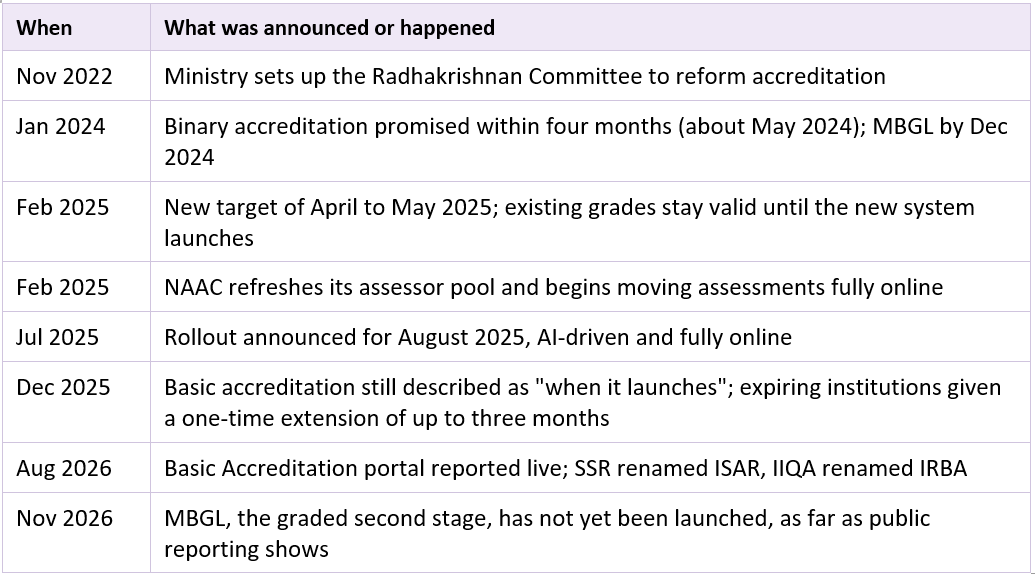
In all, Stage 1 has taken about 27 months longer than first planned, and Stage 2 is still in preparation.
Why is the NAAC binary framework delayed?
NAAC has not published a single official reason. The structure of the reform itself points to five factors working together.
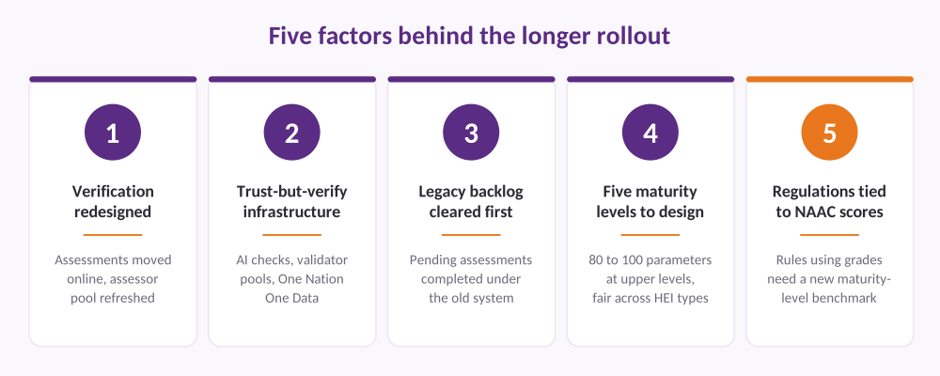
1. Verification had to be redesigned from the ground up
In 2025, concerns about the reliability of on-site peer visits led NAAC to refresh its assessor pool and move assessments online. That decision went to the heart of the old model. Verification had to be rebuilt around documents, AI-assisted checks and stakeholder validation, and the code of conduct for assessors had to be revised too.
2. A trust-but-verify system takes time to build
The new model replaces visits with data. Its guiding principle is trust, backed by verification. That requires machine-learning checks, credibility scores for assessors, a pool of randomly selected validators, and penalties of up to three years' debarment for false documents. It also leans on the One Nation One Data platform, which is meant to unify submissions to NAAC, NBA and NIRF. Each piece is new infrastructure, and an accreditation decision built on it must stand up to scrutiny.
3. The legacy backlog had to be cleared first
NAAC paused fresh registrations for a period to clear pending assessments under the old system, and by mid-2025 that work was largely complete. The old pipeline was busy: 11,829 institutions had completed cycle 1 accreditation by August 2025. Running two systems in parallel, with fee adjustments for institutions mid-process, adds administrative load.
4. MBGL is harder to design than a pass-fail test
A binary threshold is relatively simple. Five maturity levels, with 80 to 100 parameters at the upper levels, are not. NAAC set up special committees to build the MBGL methodology. The levels must separate institutions fairly across universities, autonomous colleges and affiliated colleges, and across disciplines.
5. Regulations still run on NAAC scores
This is the least discussed reason, and possibly the most important. Several regulatory privileges are tied to numeric NAAC grades. For example, institutions with a NAAC score of 3.26 or above can offer online programmes without prior UGC permission. If the score disappears, every rule that uses it must be rewritten around maturity levels. Until MBGL exists, institutions with strong grades have good reason to retain them, and regulators need a replacement benchmark.
What the delay means for institutions
Institutions with expiring grades:
These institutions face the most uncertainty. NAAC has offered extensions, first until the new system launched and later a one-time extension of up to three months. Institutions should read their own notices carefully rather than assume a blanket extension. Take a mid-sized private university whose grade lapses a few months before MBGL opens: it must decide whether to apply for basic accreditation now or wait for the graded levels, and the right answer depends on which regulatory benefits it relies on.
Unaccredited colleges:
For them the delay is a window, not a wall. Basic accreditation, with fewer parameters, a lower bar and no visits, is designed for them. A rural affiliated college that has never been assessed, for instance, can use this period to digitise its records and build the evidence it will need. Those that prepare now can be among the first accredited under the new system.
High-performing institutions:
With A+ or A++ grades they gain by holding on, because their scores still unlock regulatory benefits. They should prepare evidence for higher maturity levels, since current grade holders are expected to be able to apply directly for MBGL.
For the sector as a whole:
The bigger risk is drift. A long transition can leave IQACs idle, reduce urgency around quality, and slow progress towards the 90% accreditation goal.
What institutions should do now: a six-point readiness plan
The new system rewards institutions whose data is clean, consistent and provable. That work can start today, whatever the launch date.
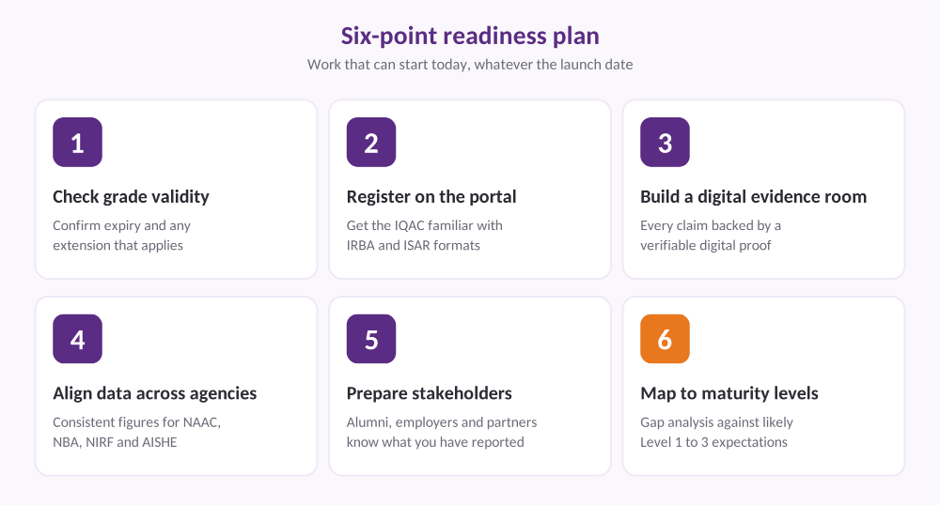
Check your grade validity and NAAC notices. Confirm your expiry date and any extension that applies to you, and plan your application window around it.
Register on the Basic Accreditation portal. Familiarise your IQAC with the new IRBA registration and ISAR self-assessment formats.
Build a digital evidence room. With no peer visit, documents are the assessment. Every claim needs a verifiable, well-organised digital proof.
Make your data consistent across agencies. Faculty, student, research and placement figures must match across NAAC, NBA, NIRF and AISHE, especially as One Nation One Data takes shape.
Prepare stakeholders for validation. Randomly selected stakeholders may be asked to confirm your claims. Alumni, employers and partners should know what you have reported.
Map yourself against the maturity levels. Do a gap analysis now against the likely Level 1 to Level 3 expectations so you can move up quickly once MBGL opens.
Frequently asked questions
Has NAAC binary accreditation started?
Partly. A Basic Accreditation portal was reported live in August 2026. The second stage, Maturity-Based Graded Levels, has not yet been launched. Check naac.gov.in for the latest notices.
Why has the NAAC binary framework been delayed?
The main factors are the redesign of verification after concerns about on-site peer visits, the need to build AI-driven online assessment, clearing the legacy backlog, designing the five maturity levels, and regulations that still depend on NAAC scores.
Is NAAC grading (A++, A+, A) abolished?
The new system replaces grades with an accredited or not accredited outcome, followed by maturity levels. Existing grades remain valid until they expire.
What is MBGL in NAAC?
MBGL stands for Maturity-Based Graded Levels. It ranks accredited institutions from Level 1 to Level 5, with Level 5 reserved for global excellence.
What happens when my NAAC grade expires before MBGL launches?
NAAC has offered extensions to such institutions, including a one-time extension of up to three months announced in December 2025. They may opt for basic accreditation once it is open to them.
Will there be peer team visits under the new system?
Not for basic accreditation, which is fully online. Physical or hybrid visits are expected only at the higher maturity levels.
Conclusion: a slow reform, but the right one
The binary framework has been slow because it is attempting something hard: moving national accreditation from peer judgement to verified data, while thousands of institutions sit mid-cycle under the old rules.
The wait has been long, but it does not change the direction. When MBGL arrives, institutions with clean data, documented evidence and an active IQAC will move fastest. Those waiting for the final notification before they start will be at the back of the queue.