
AI is not destroying careers. It is destroying a particular kind of career — and quietly raising the price of everything it cannot do.
The headlines read like an obituary for work. But the data tells a different story: AI is not wiping out careers, it is changing which skills are scarce. This guide explains the 8 AI-proof skills that AI makes more valuable, the evidence behind them, and a 90-day plan to build them.
Key takeaways
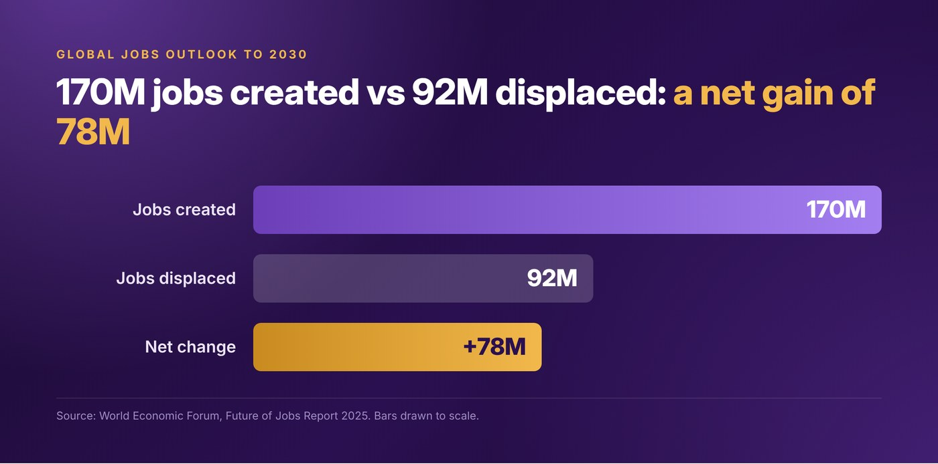
The net story is growth, not loss. The World Economic Forum projects 170 million jobs created and 92 million displaced by 2030.
The real casualty is the entry-level rung — the routine work on which careers have traditionally been built.
Scarcity has moved from producing answers to framing problems, verifying output and earning trust.
Eight skills pass the scarcity test. Below: what each one is, why AI cannot replace it, and how to build it in 90 days.
AI and jobs: the disruption is real, but selective
Organisations increasingly cite AI when announcing layoffs, entry-level hiring has slowed, and barely a week passes without a company claiming that its AI agents can do the work of an entire team.
Look closer and a different picture emerges. The World Economic Forum’s Future of Jobs Report 2025 projects that 170 million jobs will be created and 92 million displaced by 2030 — a net gain of 78 million. Work is not vanishing. What is vanishing is work built on routine, repeatable tasks that a machine can now perform faster and more cheaply.
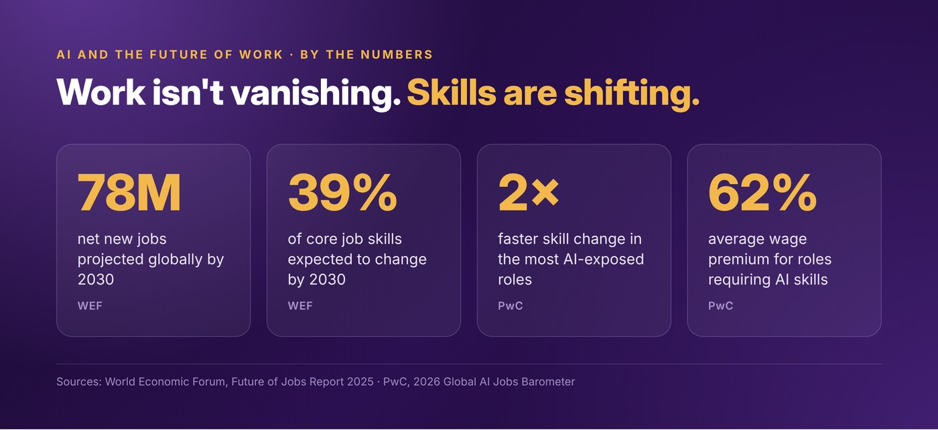
The deeper shift is in skills, and it is moving faster than most careers are designed to absorb. The WEF expects 39% of core job skills to change by 2030. PwC’s 2026 Global AI Jobs Barometer, built on more than a billion job advertisements, finds that skills in the most AI-exposed jobs are changing more than twice as fast as those in the least exposed. In other words, the half-life of what you know is shrinking — and shrinking fastest precisely where AI is most present.
The question is no longer “Will AI take my job?” It is “What can I still do that is scarce once everyone has AI?”
Where AI is really hurting careers: the missing first rung
The most significant effect of AI so far is not mass redundancy. It is something quieter and, in the long run, more consequential: the disappearance of the first rung of the career ladder. Four signals stand out.
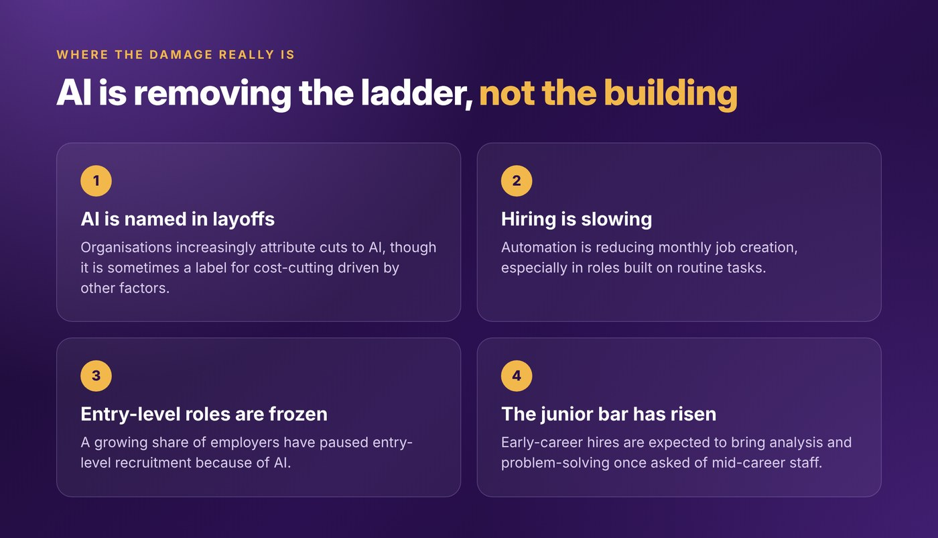
AI is named in layoffs. Employment reports show organisations increasingly attributing workforce reductions to AI adoption — though analysts caution that AI is sometimes a convenient label for cost-cutting driven by other factors.
Hiring is slowing, not just firing. Industry research indicates that automation is reducing monthly job creation, particularly in roles built on routine tasks.
Entry-level roles are frozen. Employer surveys show a growing share of companies have paused entry-level recruitment because of AI, with more expected to follow by the end of 2026.
The junior bar has risen. Across AI-exposed industries, employers now expect early-career candidates to bring analytical and problem-solving capability once associated with mid-career professionals.
This is the uncomfortable part of the story. For generations, junior professionals learned their craft by doing the routine work — drafting, checking, compiling, testing. That apprenticeship is now being automated away, and most organisations have not yet decided what replaces it.
The other side of the ledger: AI is raising the value of expert work
While AI erodes some work, it is sharply increasing the value of other work. PwC describes these as “professionalised” roles — jobs that AI reshapes to demand more expertise, not less. They see roughly twice the job growth of roles AI simplifies, with 42% faster wage growth. Jobs requiring specific AI skills grew by 69%, against 9% for the market as a whole, and they carry an average wage premium of 62%.
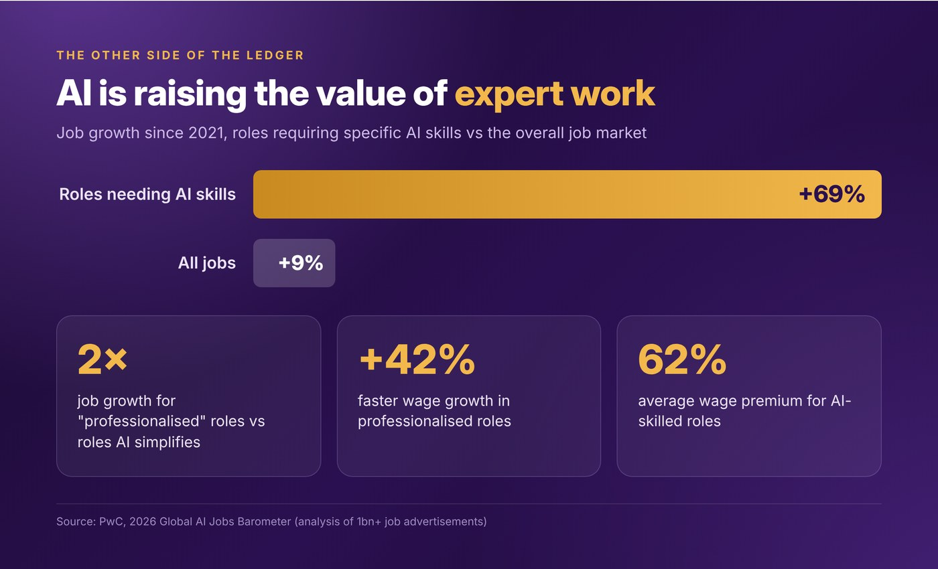
The takeaway: the winners will not be those who compete with AI on speed. They will be those who do what AI makes more valuable.
The scarcity test: what makes a skill AI-proof?
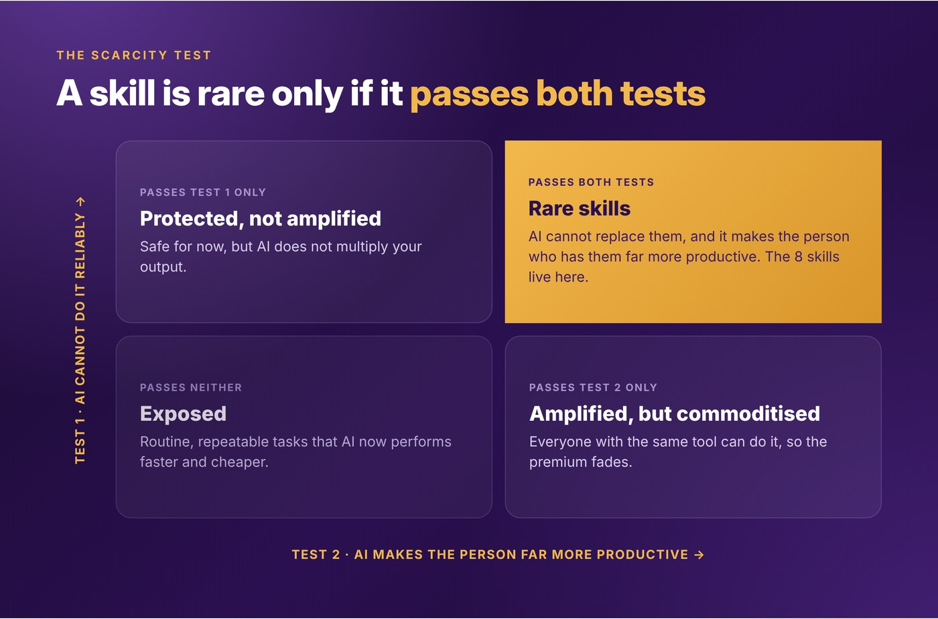
Not every “human skill” is rare. In the AI era, a capability is genuinely scarce only when it passes two tests:
Test 1: AI cannot do it reliably on its own.
Test 2: AI makes the person who has it far more productive.
Skills that pass only the first test are protected but not amplified. Skills that pass only the second are amplified but easily commoditised. The eight skills below pass both.
The 8 rare skills AI cannot replace
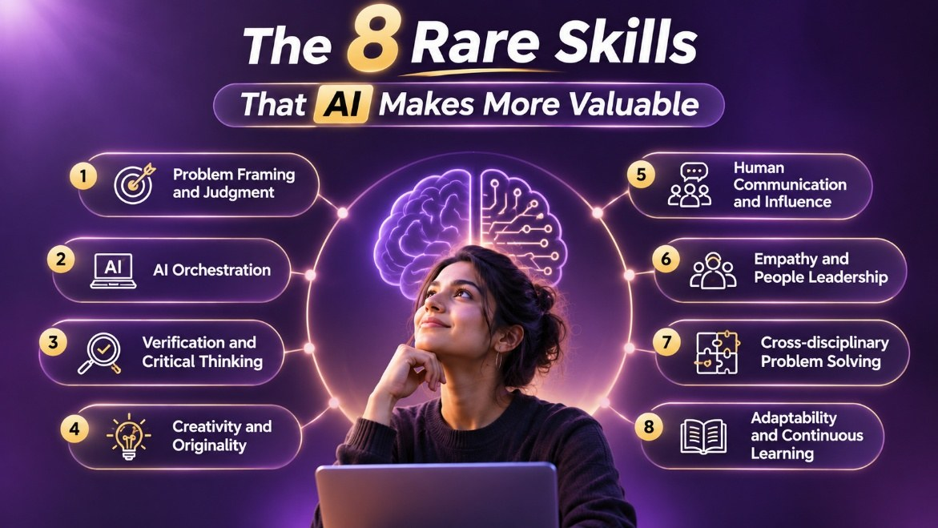
1. Problem framing and judgement
Answers are now cheap. Good questions are not.
Why AI can’t replace it: AI responds to the problem it is given. It cannot tell you whether it is the right problem, or weigh what matters when the data runs out.
What it looks like: Looking at an ambiguous situation and saying, “The real problem is X, and this is how we will know we have solved it” — then deciding which trade-offs are acceptable, and which ones should not be made at all.
How to build it: Before your next task, write one sentence defining the problem and one defining success. Compare them with what was actually asked.
2. AI orchestration
Prompting was the 2024 skill. Orchestration is the 2026 skill.
Why AI can’t replace it: Tools change monthly. The ability to design a workflow in which AI agents and people each do what they do best does not.
What it looks like: Breaking work into stages, choosing the right tool for each, setting human checkpoints and assembling the output. Consulting firms report that AI skills are moving out of engineering and into mainstream business roles, including AI-led business strategy.
How to build it: Map one recurring piece of work end to end. Mark which steps AI should do, which a person must do, and where the review points sit.
3. Verification and critical thinking
Every AI output is a draft until a competent person checks it.
Why AI can’t replace it: AI produces fabricated citations, wrong numbers and plausible-but-false reasoning with complete confidence. Spotting them requires expertise AI does not have about itself.
What it looks like: Auditing AI work quickly, knowing where it typically fails, and refusing to sign off on what you cannot defend. This is fast becoming a job requirement in law, finance, healthcare, education and software.
How to build it: Keep a verification log: every error you catch in AI output, and how you caught it. Within a month you will have a personal error map.
4. Creativity and originality
AI is brilliant at the average. Markets reward the exceptional.
Why AI can’t replace it: Generative models are built on existing patterns. They recombine well, but the genuinely new angle, the unexpected connection or the brave idea still starts with a person.
What it looks like: Using AI to generate twenty options in minutes, then recognising the one that is truly different — or rejecting all twenty and asking a better question.
How to build it: For your next piece of work, ask AI for the conventional approach first, then deliberately design the alternative it did not suggest.
5. Human communication and influence
AI can draft the proposal. It cannot be accountable for the promise.
Why AI can’t replace it: Decisions involving money, risk or reputation are still made between people, on the basis of trust built over time.
What it looks like: Sitting across the table, reading the room, absorbing an objection and moving a decision forward. Industry reports highlight client relations and executive and stakeholder communication as rising skills.
How to build it: Take ownership of one stakeholder relationship this quarter. Present, rather than circulate, your next recommendation.
6. Empathy and people leadership
As AI does more of the work, leading the people becomes more of the job.
Why AI can’t replace it: Motivation, morale, conflict and growth are human problems. Teams adopting AI need leaders who can manage anxiety as well as output.
What it looks like: Coaching, mentoring and helping colleagues adapt. Team management and mentorship are widely reported to be among the fastest-growing skills globally.
How to build it: Teach one colleague or junior a workflow you have built. Mentoring is both a rising skill and the fastest way to deepen your own.
7. Cross-disciplinary problem solving
AI excels inside a box. Valuable problems live across boxes.
Why AI can’t replace it: The most important organisational challenges — a product launch, an accreditation cycle, an institutional turnaround — span functions with competing goals. AI cannot hold that context.
What it looks like: Real depth in one domain, combined with fluency in AI and the ability to work across functions. A regulatory specialist who uses AI well is worth far more than either a specialist who does not, or an AI user with no domain.
How to build it: Identify one problem in your field that generic AI answers consistently get wrong. Become the person who knows why.
8. Adaptability and continuous learning
If skills change twice as fast, learning speed becomes the skill.
Why AI can’t replace it: Any specific tool skill has a short shelf life. The rate at which you acquire the next one compounds over an entire career.
What it looks like: Learning deliberately and in public, building small projects, and abandoning outdated methods without ego. This is a discipline, not a talent.
How to build it: Block two hours a week for structured learning, and finish each block with something you have built, not just something you have read.
5 myths about AI and jobs worth retiring
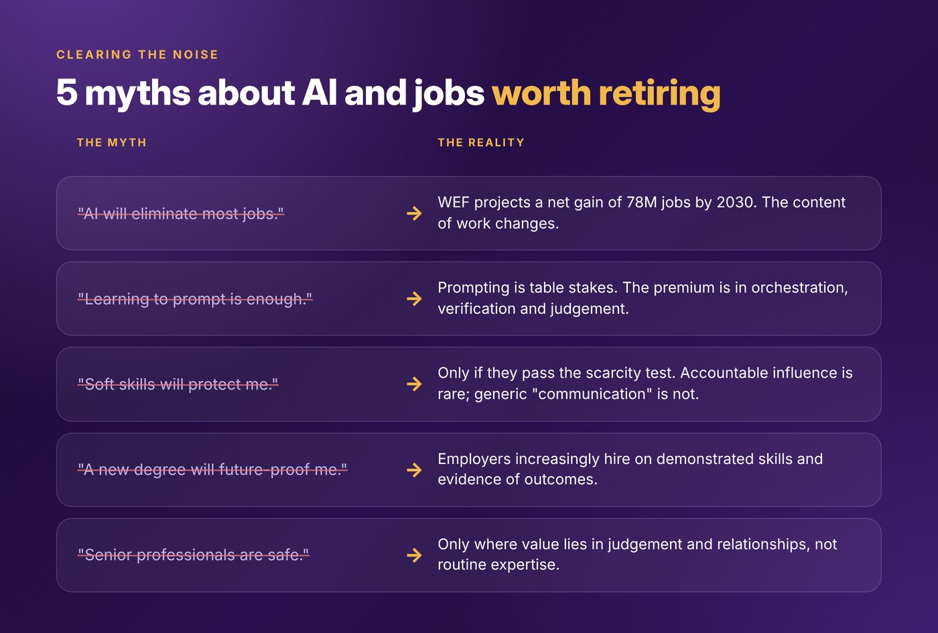
Myth: “AI will eliminate most jobs.” Reality: the WEF projects a net gain of 78 million jobs by 2030. The change is in the content of work, not its existence.
Myth: “Learning to prompt is enough.” Reality: prompting is now table stakes. The premium has moved to orchestration, verification and judgement.
Myth: “Soft skills will protect me.” Reality: only if they pass the scarcity test. Generic “communication skills” are not rare; accountable influence in high-stakes decisions is.
Myth: “A new degree will future-proof me.” Reality: degrees are losing signalling power. Employers increasingly hire on demonstrated skills and evidence of outcomes.
Myth: “Senior professionals are safe.” Reality: seniority protects only those whose value lies in judgement and relationships. Experience built on routine expertise is as exposed as any junior role.
AI and jobs in India: what it means for students, professionals and institutions
India is both highly exposed to AI disruption and unusually well positioned to benefit from it. The India Skills Report 2026 (ETS, with CII, AICTE and AIU) places national employability at 56.35%, up from 54.81% a year earlier.
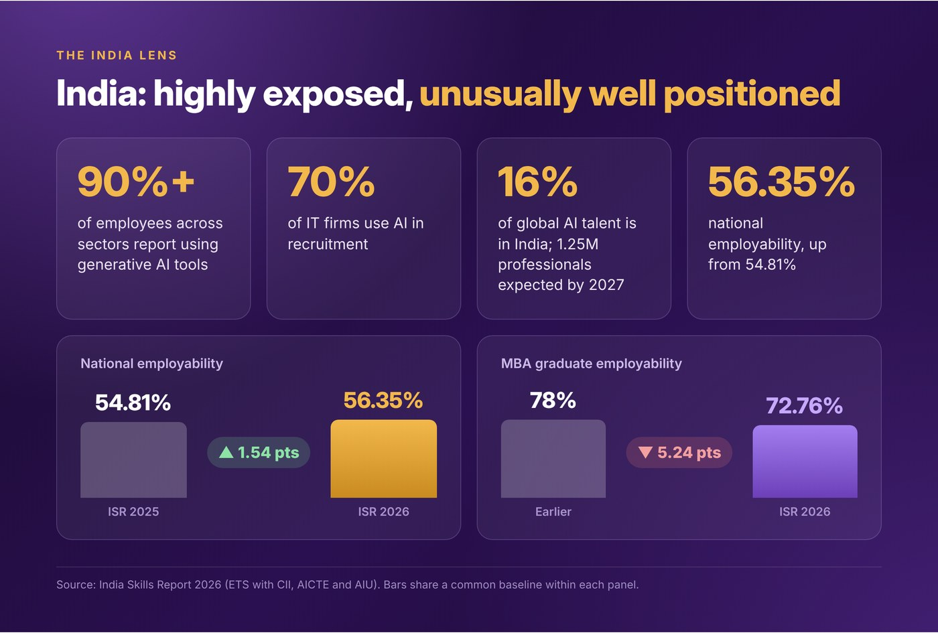
90%+ of employees across sectors report using generative AI tools.
70% of IT firms use AI in recruitment.
16% of global AI talent is in India, with 1.25 million AI professionals expected by 2027.
72.76% MBA employability, down from 78% — degrees alone are losing signal.
LinkedIn’s Skills on the Rise 2026 list for India confirms that employers now hire for skill stacks, not single skills, grouping rising skills into five stacks: AI and automation; data and analytics; IT and cybersecurity; business and growth; and people and leadership.
Students and graduates
What changes: the entry-level jobs that once taught you on the job are thinning out. Employers expect day-one capability.
What to do now: build a portfolio of evidence — projects, case studies, verified AI workflows — not just a transcript.
IT services and BPM professionals
What changes: testing, support, documentation and basic coding are precisely the tasks AI absorbs first.
What to do now: move from executing tasks to owning outcomes — client relationships, solution design and quality assurance of AI-generated work.
Colleges and universities
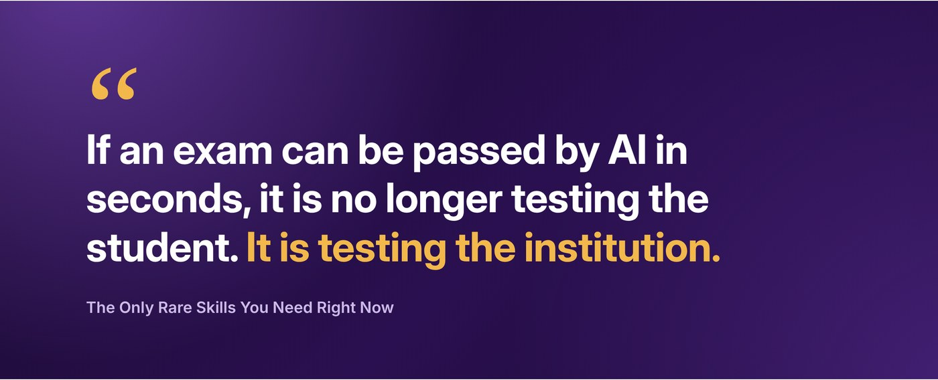
What changes: an assessment that AI can pass in seconds no longer measures what employers need.
What to do now: in line with NEP 2020’s emphasis on multidisciplinary, outcome-based education, explicitly assess judgement, verification and collaboration — not content recall.
A 90-day plan to build AI-proof skills
You do not need a new degree. You need proof that you can do what AI cannot — while using AI to do it.
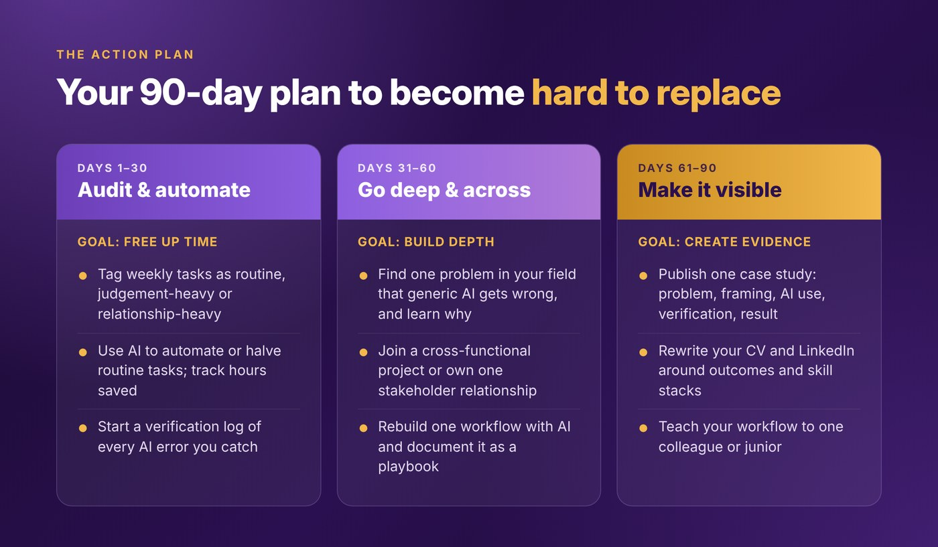
Days 1–30: Audit and automate (goal: free up time)
List your weekly tasks; tag each as routine, judgement-heavy or relationship-heavy.
Use AI to automate or halve the routine tasks. Track the hours saved.
Start a verification log of every AI error you catch.
Days 31–60: Go deep and across (goal: build depth)
Find one problem in your field that generic AI gets wrong. Learn why.
Join one cross-functional project or own one stakeholder relationship.
Rebuild one end-to-end workflow with AI and document it as a playbook.
Days 61–90: Make it visible (goal: create evidence)
Publish one case study: the problem, your framing, your AI use, what you verified, the result.
Rewrite your CV and LinkedIn profile around outcomes and skill stacks, not job titles.
Teach your workflow to one colleague or junior.
Why evidence matters: recruiters increasingly hire on demonstrated skills, and nearly half of recruiters on LinkedIn now explicitly use skills data to fill roles. A case study travels further than a certificate.
Self-check: how scarce are your skills today?
Answer honestly. Each “no” marks where to focus your next 90 days.
In the last month, have I redefined a problem before solving it?
Have I designed a workflow that combines AI tools and human review?
Have I caught, and corrected, a material error in AI-generated work?
Have I produced an idea that AI did not suggest?
Have I moved a decision forward in a meeting with a senior stakeholder?
Have I coached or mentored someone through a change?
Have I solved a problem that required working across another function?
Have I learned and applied a new tool or method in the last 90 days?
Frequently asked questions
What skills can AI not replace?
The skills AI cannot replace are those it cannot perform reliably on its own and that make the person who has them more productive when AI is used: problem framing and judgement, AI orchestration, verification and critical thinking, creativity, human communication and influence, empathy and people leadership, cross-disciplinary problem solving, and adaptability.
Will AI take my job?
For most people, AI will change the job rather than remove it. The WEF projects a net gain of 78 million jobs by 2030. The highest risk sits with routine, repeatable tasks and with entry-level roles built on them.
Is learning prompt engineering enough to stay relevant?
No. Prompting is now table stakes. The premium has moved to orchestrating AI and people in one workflow, verifying AI output, and exercising judgement about what the output means.
What are the most in-demand skills in India in 2026?
LinkedIn groups India’s fastest-rising skills into five stacks: AI and automation; data and analytics; IT and cybersecurity; business and growth; and people and leadership. Employers increasingly hire for combinations of these rather than single skills.
How long does it take to build AI-proof skills?
You can create visible evidence in about 90 days: one month to audit and automate routine work, one month to build depth, and one month to publish a case study and teach what you have learned.
The bottom line: scarcity is the new security
AI will not decide who stays relevant. Professionals will — through the skills they choose to build and the evidence they create. Those who frame problems, verify outputs, generate original ideas, earn trust and take accountability will find that AI makes them more valuable, not less.
The window to make this shift deliberately — rather than under pressure — is open now. It will not stay open indefinitely.
If this was useful, follow for more on AI, skills and the future of higher education and work — and share the self-check with someone planning their next career move.