

Institutions uploaded their NIRF data on 16 March 2026, and the Sustainable Institutions category closed a week later. The rankings normally follow in August or September. It is now mid-November, and the Ministry of Education has neither released India Rankings 2026 nor named a revised date.
Stakeholders are frequently visiting NIRF portal but to no avail. Vice-Chancellors are fielding questions from boards and trustees about new rankings. Admissions teams are planning the 2027 cycle without a fresh number to quote. Everyone is asking the same question: why is there a delay in announcing the NIRF ranking this year?
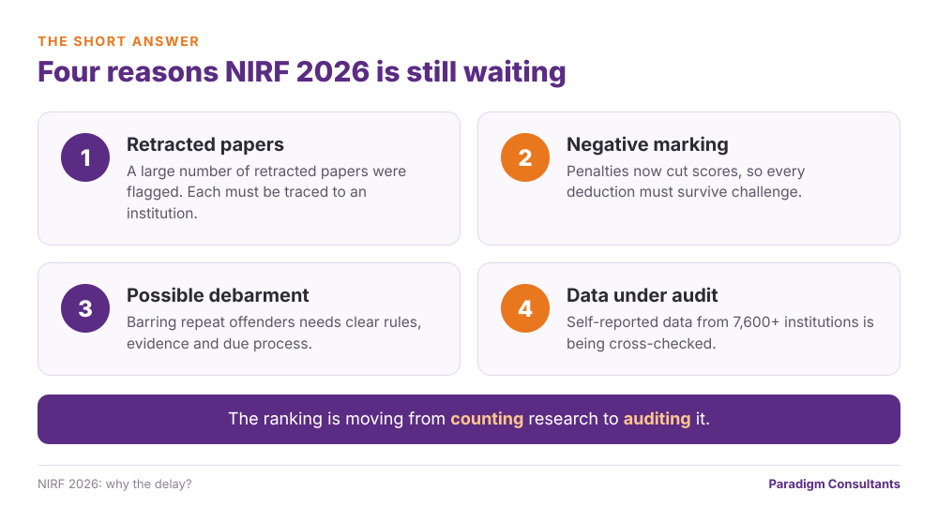
In brief: NIRF 2026 is late because the ranking is moving from counting research to auditing it. Four things are slowing it down: a large number of retracted papers flagged during assessment, negative marking that must now survive challenge, the possible debarment of repeat offenders, and tighter checks on self-reported institutional data.
No official reason has been given. But each of these four causes is visible in how the ranking framework has changed over the past year, and together they explain the wait.
Is this delay unusual?
Yes, and it is part of a trend. The first four editions were released in the first week of April. Since 2020, the date has drifted steadily later, and 2026 has already overshot every previous edition.
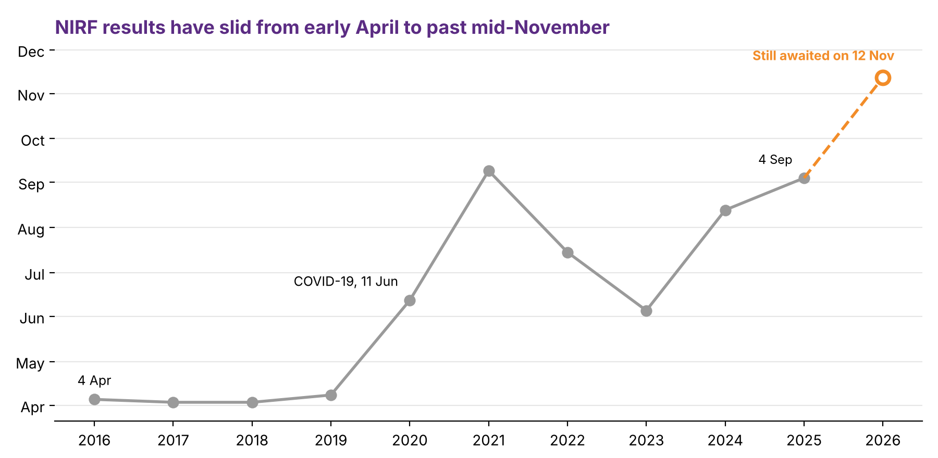
Each slip has had a cause: the pandemic lockdown in 2020, a legal challenge in 2025, and now the integrity review of 2026. The pattern matters more than any single year, because a ranking released after admissions planning is a ranking that matters less to students.
Reason 1: A wave of retracted research papers
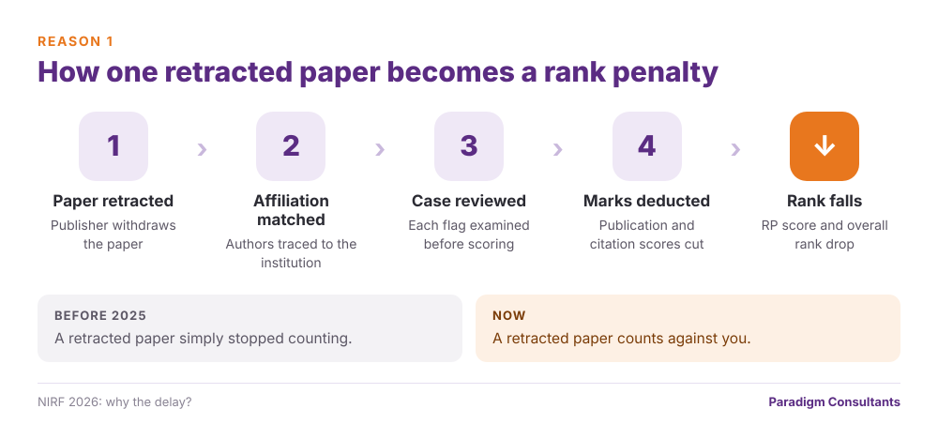
This year’s assessment has reportedly flagged a large number of retracted papers carrying Indian institutional affiliations. The National Board of Accreditation (NBA), which runs NIRF for the Ministry, has to examine each flagged case before scores can be finalised.
The scale explains the time it takes. India now ranks among the top countries in the world for research retractions, and each paper has to be matched to an institution through author affiliations before any penalty can be applied fairly.
Illustration: Consider a mid-sized private university, call it University X, that pushed faculty to publish “anything, anywhere” to lift its research score. Three years later, two dozen of its papers in a single journal are retracted after a publisher investigation. Under the old rules, those papers simply stopped counting. Under negative marking, they count against it.
Reason 2: Negative marking has raised the stakes
NIRF had never deducted marks until 2025. That year, a minor penalty for retractions was introduced, cutting publication and citation scores, with clear signals that penalties would grow heavier in later cycles. Draft norms extending negative marking to poor-quality research and to citations of tainted work followed.
A stiffer penalty raises the stakes of every deduction. A computed rank that can drop an institution several places has to survive challenge, so verification slows down.
Reason 3: Debarment of repeat offenders needs due process
Barring repeat offenders from future NIRF cycles is reportedly under consideration, though it has not been confirmed as a final decision. A sanction of that weight needs clear rules, due process and documented evidence, all of which take time.
Reason 4: Self-reported data is under a stronger lens
NIRF scores are built on data that institutions submit themselves. That model has been questioned for years, and verification has steadily tightened, including the use of external agencies to cross-check submissions. More checking, across more than 7,600 participating institutions, means a longer cycle.
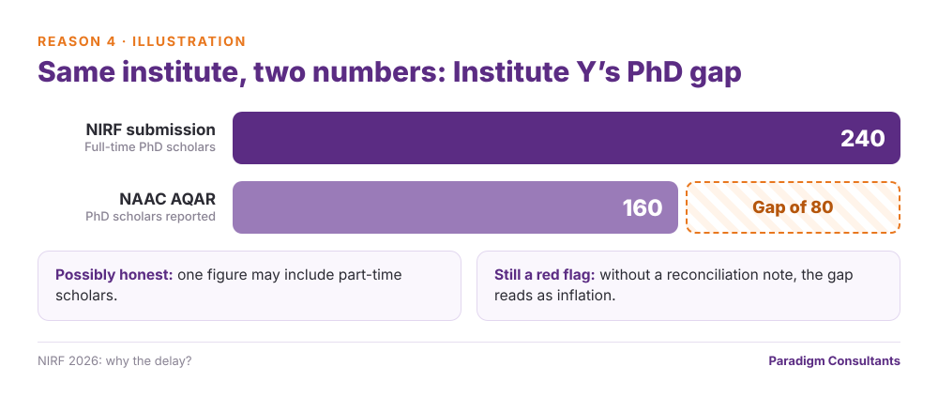
Illustration: Institute Y reports 240 full-time PhD scholars to NIRF but 160 in its NAAC AQAR. Neither figure may be false; one may include part-time scholars. But without a reconciliation note, the gap reads as inflation, and an auditor will treat it that way.
The reason behind the reasons: NIRF’s credibility test
The 2026 delay is the second in a row, and both trace back to one question: can a ranking built on self-declared data be trusted?
In 2025, publication of the rankings was briefly held up by litigation alleging that institutional data was unverified, and that NIRF submissions did not match figures reported elsewhere on PhD students, faculty and funds. The hold was lifted once the Centre explained that an expert-designed methodology was being followed, and the 2025 list finally appeared on 4 September 2025.
Independent analyses have since compared institutions’ NIRF submissions with their own annual reports and found mismatches and calls to publish the full dataset for public audit have grown louder. The NBA is no longer just computing scores; it is defending them. Every penalty, and every rank it changes, must hold up before institutions, the public and, if needed, a court.
So when will NIRF 2026 be announced?
No official date has been announced. Sector expectation points to a release before the end of 2026, but the Ministry of Education has not confirmed this. There is no indication that the cycle has been cancelled: data collection closed in March, and the process is still in verification. When the list arrives, it will appear on NIRF portal.
What the delay means for you
For students and parents: The 2025 list remains the latest official reference. Treat any “NIRF 2026 top colleges” list circulating online as a forecast or a recycled 2025 table until it appears on. When the 2026 list arrives, compare it with 2025 and look for stable performers rather than one-year jumps.
For research-heavy institutions: Research and Professional Practice is where penalties land. An institution that has leaned on publication volume may see its RP score fall, and its overall rank with it.
For Vice-Chancellors and boards: A rank is now also a reputational exposure. Imagine College Z sliding a dozen places because of retraction penalties: its leadership will spend the next admissions season explaining the fall to students, recruiters and regulators, rather than marketing its strengths.
For the system as a whole: A slower, stricter NIRF is a better NIRF. Rankings that reward verified quality over inflated volume serve students, and they protect institutions that have been reporting honestly.
What institutions should do while they wait
The wait is useful time. Institutions that act before the 2027 data window opens will be the ones that gain when penalties tighten. Here is a six-point integrity checklist.
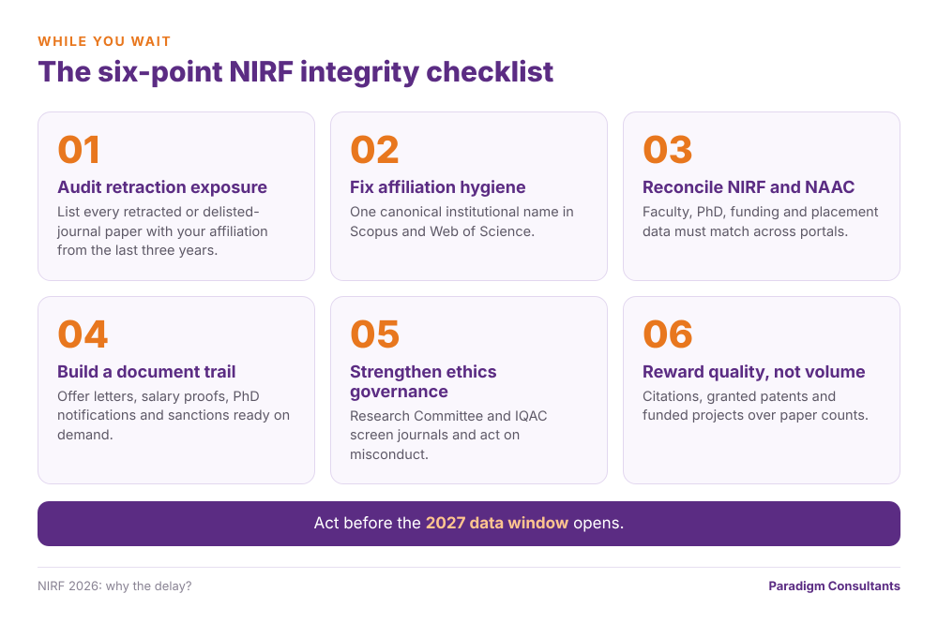
Audit your retraction exposure. Pull every retracted or delisted-journal paper carrying your affiliation from the last three years. Know your number before the NBA tells you.
Fix affiliation hygiene. Ensure faculty use one canonical institutional name in Scopus and Web of Science, so credit and accountability both land correctly.
Reconcile NIRF with NAAC and annual reports. Faculty counts, PhD numbers, research funding and placement data must match across every portal you report to.
Build a document trail. Keep offer letters, salary proofs, PhD notifications and sponsored-research sanctions ready for verification on demand.
Strengthen research ethics governance. Empower the Research Committee and IQAC to screen journals, check for plagiarism and act on misconduct.
Shift incentives from volume to quality. Reward citations, patents granted and funded projects, not paper counts in questionable journals.
Frequently asked questions
Why is there a delay in announcing the NIRF 2026 ranking?
The delay is linked to scrutiny of a large number of retracted research papers, the application of negative marking, the possible debarment of repeat offenders, and wider checks on institutional data.
When will NIRF 2026 be released?
No official date has been announced. A release before the end of 2026 is expected but not confirmed. The list will appear on NIRF portal.
Has NIRF 2026 been cancelled?
There is no indication of cancellation. Data collection for India Rankings 2026 closed in March 2026, and the cycle is still in verification.
How do retracted papers affect an NIRF score?
Since 2025, retractions reduce an institution’s publication and citation scores under Research and Professional Practice. Penalties are expected to become stricter in later cycles.
How many categories will NIRF 2026 cover?
NIRF 2025 ranked institutions across 17 categories, and the 2026 edition is expected to follow the same structure.
Should students wait for NIRF 2026 before choosing a college?
Not necessarily. The 2025 rankings remain valid, and a multi-year view is more reliable than any single list.
Conclusion: the delay is the message
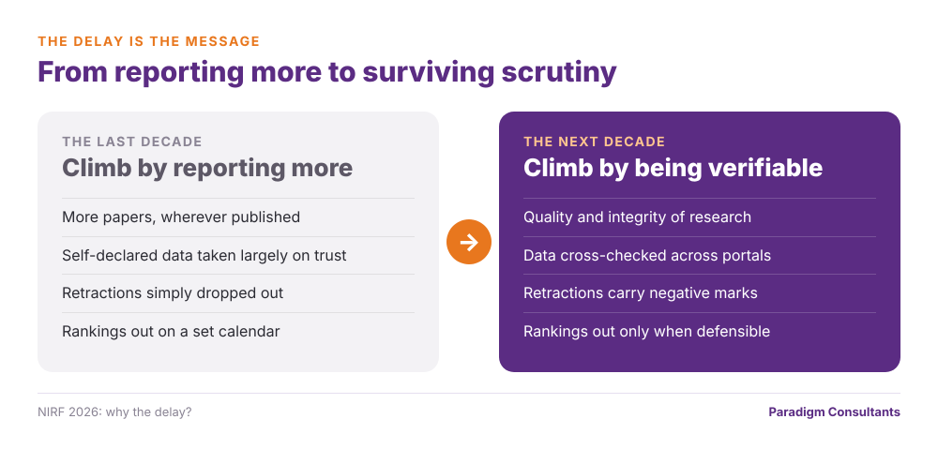
So why is the NIRF ranking delayed? Because, for the first time, the numbers are being checked before they are ranked. For a decade, institutions climbed by reporting more: more papers, more PhDs, more numbers. The next decade will reward institutions whose numbers survive scrutiny.
When the 2026 list arrives, the headline will be who rose and who fell. The more important story will be who was penalised, and why.